Why Is Medicai the Best for Image-routing Capabilities?
Many imaging teams still route scans through multiple vendors and email threads. The result is lost studies, repeated uploads, and delays reaching specialists.
By the end of this article you will know how Medicai's uploader, DICOM gateway, and cloud PACS fit together to move studies from scanner to viewer without extra servers. You will also see pricing tiers, security certifications, and the exact care settings that benefit most.
What Is Medicai?
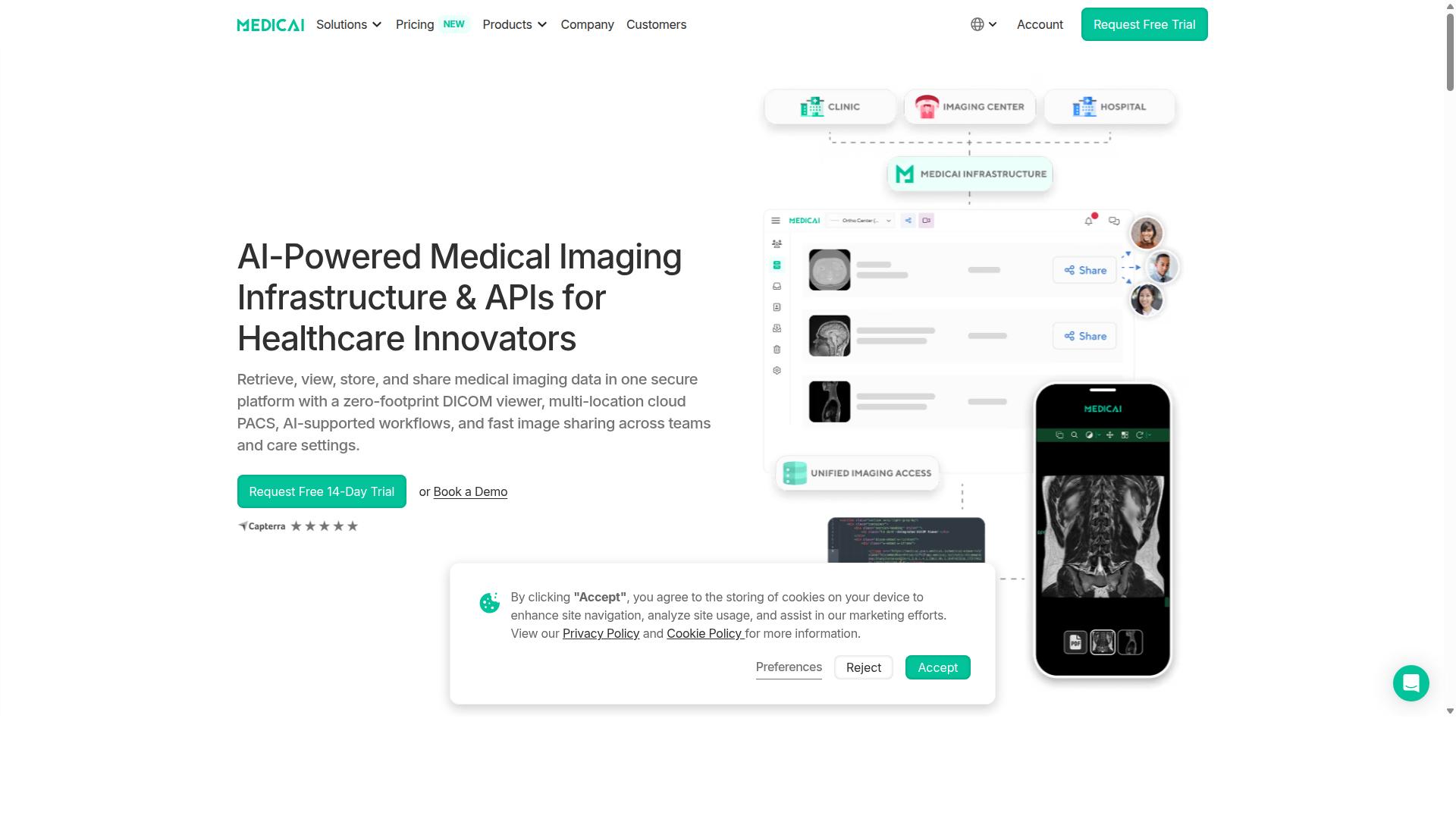
Medicai is a cloud-based medical imaging platform that centralizes retrieval, viewing, storage, and sharing of imaging data through a single secure interface.
The system relies on a zero-footprint DICOM viewer that runs directly in any web browser. Healthcare providers can open studies immediately without installing software or managing local updates.
Medicai supports Imaging Infrastructure as a Service and offers a multi-location cloud PACS that stores and routes imaging data across different care settings. This architecture supports interoperability between teams and facilities.
The platform maintains HIPAA and GDPR compliance through data encryption, access controls, and audit trails that protect patient information at every step of the workflow.
Healthcare organizations use Medicai to replace fragmented local solutions with a unified system that handles medical imaging data securely and consistently. The focus remains on reliable delivery and secure access without added local infrastructure.
Why Medicai Excels at Image Routing
Routing performance is measured by the 50 million yearly API transactions Medicai processes while maintaining sub-second study delivery across global sites. The platform evaluates DICOM tags to determine modality type, body part examined, and referring physician. These values trigger automated routing decisions without manual intervention.
DICOM tag-based rules examine patient demographics and study description fields. When specific values match predefined conditions, the system directs studies to designated workstations or remote servers. This approach eliminates delays that occur with manual routing processes.
Load-balancing logic monitors current site volume and available bandwidth across connected locations. Studies are distributed to sites with lower current loads, which prevents bottlenecks during peak imaging periods. The algorithm adjusts routing paths based on real-time network conditions.
Latency benchmarks result from lossless compression combined with regional edge nodes positioned near clinical facilities. This combination reduces transmission times while preserving full image quality required for diagnostic accuracy.
Medicai processes over 1 million studies annually and maintains 1.7 million studies in storage. The platform supports 70 clinics and hospitals along with over 10,000 active doctors. These operational figures demonstrate the system's capacity to handle large-scale image-routing demands across multiple healthcare environments.
Key Features and What Makes Medicai Stand Out
Three functional pillars, connect, store, and access, work together to eliminate fragmented imaging workflows.
Each pillar addresses a distinct stage of the radiology workflow. The connect pillar handles ingestion and validation. The store pillar ensures secure retention and availability. The access pillar enables real-time viewing and collaboration.
These capabilities align with image-routing needs by supporting interoperability and reducing latency. Radiologists and referring physicians gain consistent access across locations and systems.
The following subsections outline how each pillar functions within Medicai.
CONNECT & RETRIEVE: Medical Imaging Uploader, DICOM Gateway
The uploader ingests studies directly from any modality via HL7/FHIR worklist queries, automatically compressing images losslessly before transmission.
Studies arrive from modalities such as CT, MRI, or ultrasound. The system queries the modality worklist to match accession numbers and patient demographics before routing begins.
Once matched, the DICOM Gateway validates each study against expected identifiers. This step prevents misrouting and ensures the correct patient record receives the images.
Lossless compression reduces file size during transfer. Bandwidth usage drops without sacrificing diagnostic quality.
Validated studies continue through the routing process based on modality type, study description, or body part examined. Routing rules can prioritize urgent cases automatically.
STORE & MANAGE: Cloud PACS, Medical Image Exchange, Vendor Neutral Archive
Stored studies reside in a vendor-neutral archive replicated across HIPAA-compliant data centers with full encryption at rest and in transit.
The Cloud PACS tier in the Standard plan includes 2 TB of storage. This capacity supports multi-site connectivity without immediate infrastructure upgrades.
Disaster-recovery failover keeps images available during outages. Data replication occurs across separate locations to maintain continuity.
Each access event records specific audit-trail fields. These fields include user identity, timestamp, and action performed on the study.
The Medical Image Exchange layer supports transfer between facilities. Vendor-neutral architecture prevents lock-in while maintaining compatibility with existing PACS environments.
ACCESS, VISUALIZE, COLLABORATE: Doctor Imaging Portal, Patient Imaging Portal
The Doctor Portal lets referring physicians and radiologists open full-resolution studies in-browser, while the Patient Portal grants secure, time-limited access.
Real-time collaboration occurs through the portals. Multiple users can view the same study simultaneously and discuss findings without physical co-location.
Over 300 k visualizations recorded last year demonstrate active usage across clinical teams. This volume reflects the demand for immediate image access in teleradiology settings.
Report-turnaround notifications reach external EHR systems through HL7/FHIR messaging. The integration reduces manual follow-up and keeps referring physicians informed.
Both portals maintain HIPAA compliance during viewing and sharing. Encryption protects data during transmission and while displayed on screen.
Pricing and Plans
Two subscription tiers are billed monthly: Starter at $249 for 500 GB and Standard at $749 for 2 TB with one connected location. Both plans include unlimited user accounts, making them suitable for teams of various sizes that require reliable image-routing capabilities.
Enterprise customers receive custom pricing that scales with storage and connectivity needs. This tier supports multiple connected locations plus external sites, which proves essential for organizations managing complex medical imaging workflows across different facilities.
| Plan | Monthly Price | Storage | Connected Locations | User Accounts |
|---|---|---|---|---|
| Starter | $249 | 500 GB | None | Unlimited |
| Standard | $749 | 2 TB | One | Unlimited |
| Enterprise | Custom | Custom | Multiple | Unlimited |
Overage storage follows a simple structure. Additional capacity is billed per 100 GB blocks, allowing predictable cost management as imaging volumes grow beyond base plan limits.
Yearly billing provides savings for committed users. Starter drops to $209 monthly and Standard drops to $639 monthly when paid annually. This option helps organizations reduce expenses while maintaining robust image-routing infrastructure.
DICOM Gateway Setup costs $1,000 one-time per location. This fee applies when organizations need to establish connections between Medicai and existing PACS or modality systems for seamless medical imaging transfer.
Enterprise customers can access per-study pricing models. This flexible arrangement accommodates variable imaging volumes without fixed storage commitments, particularly useful for teleradiology groups and multi-site radiology practices.
A 14-day trial of Starter plan features is available without requiring a credit card. This trial period allows teams to evaluate image-routing performance and interoperability features before making financial commitments.
Trust Signals
Compliance certifications and usage metrics together provide measurable proof of platform reliability.
FDA and CEE clearance confirm that Medicai viewers meet strict regulatory standards for medical imaging workflows. These clearances establish the platform as a trusted option for handling DICOM studies across healthcare environments.
Annual processing reaches 1M+ studies while 1.7M studies remain archived in the system. These numbers demonstrate consistent performance and capacity for high-volume image routing demands.
Partnerships with Microsoft Azure and Amazon AWS provide external validation of infrastructure quality. Enterprise organizations rely on these third-party relationships when evaluating cloud PACS solutions for teleradiology operations.
Additional trust indicators include HIPAA and GDPR compliance along with adherence to OWASP security guidelines. These protections support secure data exchange across multi-site connectivity and hybrid deployment scenarios.
Seventy clinics and hospitals currently operate on the platform with over 10,000 active doctors utilizing its image routing capabilities. This adoption across diverse healthcare settings reflects the platform's interoperability with existing PACS infrastructure.
Who Should Use Medicai
Hospitals, imaging centers, and specialty groups that need scalable, compliant image exchange across multiple sites are the primary adopters.
Orthopedics teams rely on routing rules that direct joint and fracture studies to specialists based on body part examined.
Neurology departments use similar logic to send head and spine imaging to neuroradiologists, reducing turnaround times for urgent cases.
Oncology programs route tumor follow-up scans to readers experienced with specific cancer types, ensuring consistent interpretation across treatment cycles.
Radiology groups balance general and subspecialty reads through automated assignment that considers modality type and study description.
Cardiology practices apply rules that prioritize cardiac CT and MRI studies to cardiothoracic radiologists while maintaining workload distribution.
Global availability allows teleradiology networks to connect sites across regions without changing existing PACS infrastructure.
Virtual care providers and telemedicine platforms integrate these routing capabilities to support remote consultations and multi-site coverage.
Medical education organizations and clinical trials benefit from the same routing precision when distributing studies for review or annotation.
Final Verdict
Medicai delivers an integrated, globally accessible imaging platform whose volumes and compliance certifications justify consideration by any multi-site provider.
The platform handles 50 M API calls each month. This volume demonstrates reliability at scale.
One million studies move through the system every year. The archive already contains 1.7 M studies and continues to grow.
These numbers reflect consistent performance across different institutions and network conditions. They also show that the routing engine can manage high throughput without interruption.
Providers seeking image-routing capabilities benefit from a system that already operates at this level. The same infrastructure supports both cloud PACS and hybrid deployment models.
Compliance with HIPAA requirements and data encryption standards adds another layer of assurance. Audit trails record every transaction for review and reporting.
Multi-site organizations can connect existing DICOM nodes and PACS systems through standard HL7 and FHIR interfaces. Routing rules based on DICOM tags, modality type, and body part examined help direct studies to the correct readers.
Teams that need teleradiology support can rely on the same routing logic to reduce latency and balance workloads across locations.
Organizations ready to evaluate these capabilities can contact the company through the channels listed below.
Medicai USA is located at 7901 4th St N, STE 300, St. Petersburg, FL, 33702. The phone number is +1 (832) 220 1035.
Medicai Romania operates from 53-55 N Filipescu, 5th Floor, Sector 2, Bucharest, 020961. The local phone number is +40 316 305 875.
General inquiries can be sent to [email protected].
Recommended Resources: