Why Is Medicai the Best for Workflow Solutions?
Many radiology teams still lose hours each week moving studies between incompatible systems before a single report reaches the referring physician.
That delay compounds when patient records sit in multiple locations and the only reliable viewer lives on a single workstation. By the end of this article you will see exactly which platform components address these hand-offs, where the new workflow removes steps, and what remains unchanged for your current IT setup.
What Is Medicai?
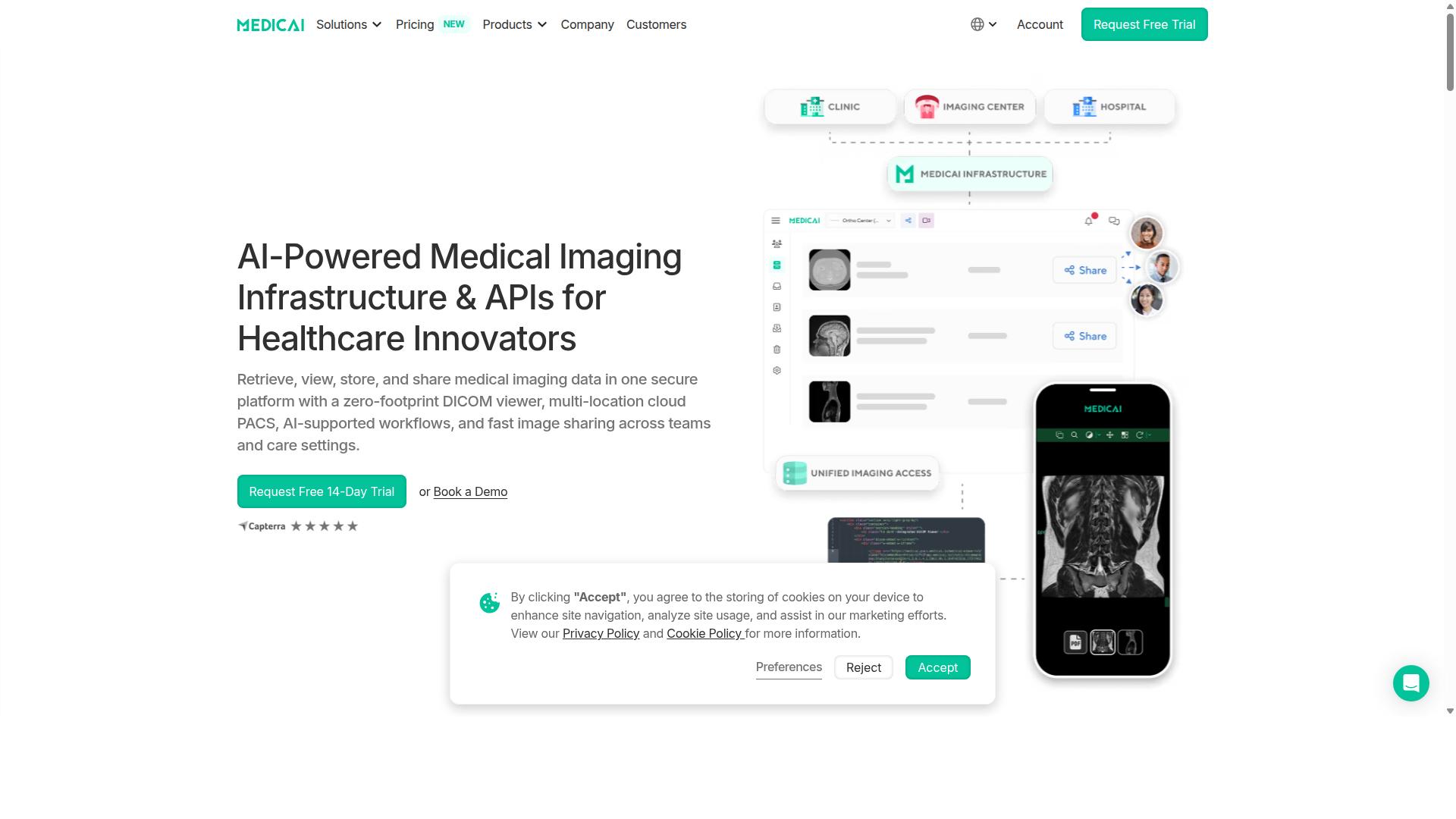
Medicai is a cloud-based medical imaging platform that centralizes the retrieval, viewing, storage, and sharing of medical imaging data through a single secure interface. The system operates as Imaging Infrastructure as a Service and supports healthcare providers across multiple care settings.
Zero-footprint DICOM viewer technology allows users to access images without installing software on local devices. This approach reduces setup time and eliminates hardware compatibility concerns that often slow down radiology workflow processes.
The platform combines multi-location cloud PACS capabilities with AI-supported workflows to streamline image management. Healthcare teams can access patient data from any location while maintaining consistent performance across different departments and specialties.
Security remains a core priority through HIPAA and GDPR compliance measures. Data encryption protects patient information during transmission and storage, while audit trails track all access events to ensure regulatory adherence.
Interoperability features enable connections with existing EMR systems and support HL7 FHIR standards. This connectivity allows seamless integration into current healthcare IT environments without requiring extensive infrastructure changes.
Fast image sharing capabilities support collaboration between care teams, referrers, and specialists. The platform enables teleradiology workflows that extend diagnostic services beyond traditional geographic boundaries while preserving image quality and security standards.
Why Medicai Is the Best for Workflow Solutions
Medicai accelerates radiology workflow by replacing fragmented tools with one platform that moves imaging data between locations and specialists in seconds. The platform supports HL7 FHIR connectivity for seamless data exchange across existing healthcare systems. This approach helps reduce the delays that commonly occur when organizations rely on multiple disconnected applications.
Automated routing ensures studies reach the right specialists without manual intervention. Real-time access allows clinicians at different sites to review cases simultaneously. These capabilities become essential when hospitals need to coordinate care across multiple locations.
Scale demonstrates the reliability of these workflow solutions. Medicai processes over 1 million studies each year while maintaining secure connections between 70 clinics and hospitals. This volume shows that the platform handles substantial workloads without compromising performance or security standards.
API connectivity supports 50 million transactions annually, enabling smooth integration with existing hospital systems. The platform serves over 10,000 active doctors who rely on consistent access to imaging studies. These usage patterns reflect the platform's ability to support daily clinical operations across diverse healthcare settings.
Security compliance includes HIPAA and GDPR standards along with OWASP guidelines. Microsoft Azure infrastructure provides the foundation for reliable data handling. These security measures allow organizations to maintain patient privacy while enabling the collaboration that modern radiology workflows require.
Key Features and What Makes Medicai Stand Out
The platform combines cloud storage, a browser-based viewer, and AI-assisted tools to create an end-to-end imaging workflow that integrates with existing EMRs.
This overview introduces three essential capabilities that shape daily radiology operations. Each area comes with measurable performance targets that clinicians can track.
The first subsection reviews storage tiers and audit reliability. The second examines real-time collaboration through the viewer. The third explores API traffic and automated routing outcomes.
Cloud PACS and Secure Image Management
Cloud PACS replaces on-premise servers with encrypted, geo-redundant storage that includes built-in backup and disaster recovery.
The Starter tier provides 500 GB of cloud storage while the Standard tier expands to 2 TB. Both plans support unlimited user accounts and automatic scaling when demand rises.
Every access event is recorded through automated audit trails. These logs supply compliance evidence and speed up internal reviews.
The service promises a 99.9 percent uptime SLA. Infrastructure on AWS and Azure delivers the redundancy needed to meet this target.
Zero-Footprint DICOM Viewer and Collaboration Tools
The zero-footprint viewer launches instantly inside any browser or mobile device, allowing clinicians to review, annotate, and share studies without installing software.
Multiple users can open the same case together. Live pointer sharing lets each participant highlight findings while the session is recorded for later reference.
Instant referral network links connect outside specialists. Every interaction is logged to satisfy regulatory requirements.
AI-Supported Workflows and Fast Image Sharing
AI integrations automatically pre-process images for triage and feed quantitative insights directly into structured reports.
The platform processes over 50 million API transactions each year. Third-party models such as Rayscape and MD.ai receive study data in real time and return results within the same session.
Automated routing rules send images to the correct specialist within 30 seconds. This speed supports timely decisions across multiple locations and specialties.
Pricing and Plans
Medicai offers transparent monthly subscriptions that scale from small practices to multi-site health systems.
The Starter tier costs $249 per month. This plan includes 500 GB of cloud storage and supports unlimited user accounts with no connected locations. Organizations with simpler needs can start here and expand later.
The Standard tier costs $749 per month. This plan provides 2 TB of cloud storage, unlimited user accounts, and supports one connected location. It suits growing practices that require additional integration capacity.
Yearly billing saves 15 percent. The Starter plan drops to $209 per month when paid yearly. The Standard plan drops to $639 per month when paid yearly.
Enterprise customers receive custom pricing. This tier offers flexible cloud storage, multiple connected locations, and multiple external locations to meet complex organizational requirements.
A one-time DICOM Gateway setup fee of $1,000 applies per location. Per-study pricing is available for enterprise customers who prefer usage-based billing instead of fixed monthly rates.
Every new account includes a free 14-day trial of Starter plan features. No credit card is required to begin the trial period.
Trust Signals
Independent audits and regulatory clearances establish Medicai's suitability for handling protected health information.
Healthcare organizations need evidence that their chosen workflow solutions meet strict security and compliance requirements. Medicai demonstrates this commitment through documented regulatory clearances and large-scale operational metrics that validate platform reliability.
The platform currently holds 1.7M+ studies in storage with 300k+ visualizations of DICOM studies performed in the past year. These numbers reflect sustained usage across clinical environments where medical imaging workflows require consistent performance.
Compliance certifications include FDA and CEE cleared viewers alongside HIPAA and GDPR compliance. These clearances enable healthcare providers to use the platform for diagnostic workflows without additional regulatory overhead.
Security practices follow OWASP guidelines with data encryption standards that protect patient information throughout the imaging workflow. The platform operates on Microsoft Azure infrastructure which adds enterprise-grade hosting protections.
These trust signals matter because radiology workflows and teleradiology operations depend on secure data handling. Organizations managing medical imaging workflows need assurance that their chosen platform maintains compliance while delivering the technical capabilities required for daily clinical operations.
Who Should Use Medicai
Hospitals, imaging centers, and specialty groups that need fast, compliant image exchange across locations will benefit most from Medicai. The platform serves healthcare providers including hospitals, imaging centers, and specialty care providers such as orthopedics, neurology, oncology, radiology, cardiology, ophthalmology, ob-gyn, pulmonology, dentistry, and gastroenterology.
Virtual care providers, telemedicine platforms, teleradiology services, and tumor boards also rely on Medicai for secure image sharing. Clinical trials, medical education organizations, and personal injury lawyers use its capabilities to access and review patient imaging without delays or compliance risks.
Patients receive direct access through the Patient Portal. This broad reach ensures that every participant in the care process can view and share medical imaging within a single, compliant system.
EMR integration plays a central role in reducing duplicate scans. When imaging data flows directly between systems, physicians see prior studies before ordering new ones, which prevents unnecessary radiation exposure and cost.
Referral leakage decreases when specialists can review images immediately through the integrated workflow. Referring physicians stay connected to the care loop because reports and images return automatically to their EMR rather than requiring separate follow-up requests.
Multi-specialty practices gain the most from this approach. Orthopedics teams review trauma studies while oncology groups examine serial imaging for treatment response, all within the same platform that feeds data back to the central record.
Final Verdict
Medicai delivers measurable workflow gains by combining enterprise-grade PACS functionality with an intuitive zero-footprint viewer and transparent pricing.
The platform supports unlimited users across locations while maintaining global accessibility through its cloud infrastructure. This design removes traditional barriers that can slow collaboration between departments or sites.
Research suggests that teams handling high imaging volumes benefit from systems built for scale. Medicai processes over 1 million studies annually, demonstrating consistent performance under real-world clinical demands.
Healthcare organizations seeking streamlined radiology workflows and reliable medical imaging access have a clear option. Contact the sales team at [email protected] to arrange a personalized demo that matches your specific operational needs.
Recommended Resources: